I’ve watched climate negotiations stall for decades. The same pattern repeats: experts from different fields talk past each other, each convinced their discipline holds the answer.
They're all wrong.
Climate change doesn’t respect disciplinary boundaries. Neither does inequality, resource depletion, or any other challenge we face today. These problems connect across systems in ways that make traditional problem-solving obsolete.
Why We Need to Go Beyond Systems Thinking
Let me be clear: adopting a systems thinking framework represents a quantum leap from how most organizations still operate today. Moving from siloed, single-discipline approaches to mapping connections, understanding feedback loops, and finding leverage points is revolutionary work.
If your organization hasn’t made that shift yet, that’s your first priority.
But here’s what I’ve learned after championing systems thinking: even systems thinking requires you to draw boundaries. You have to decide what’s in your system and what’s out. That approach worked brilliantly when problems stayed relatively contained.
Today’s challenges don’t stay contained.
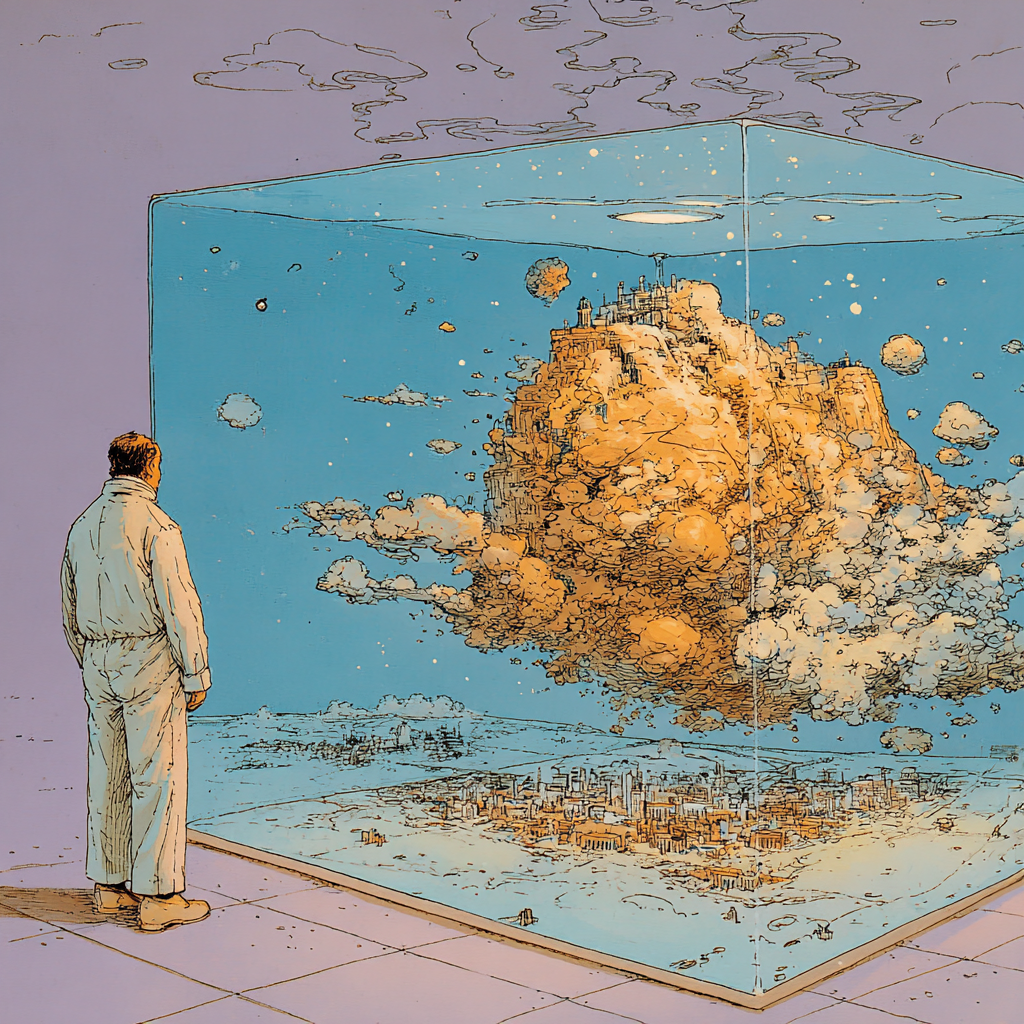
Research from 2025 confirms what many of us suspected. Global sustainability issues now involve waste management, climate change, resource depletion, biodiversity loss, and social equity all at once. They show nonlinear behaviors. They raise profound ethical questions. Systems thinking gives us the tools to understand complex systems—but to truly move forward, we need to look at the megasystem. Everything all at once over time, back and forth.
From Renaissance Individual to Renaissance Team
Leonardo da Vinci could master multiple disciplines because the knowledge base was smaller. One brilliant mind could hold it all.
That era ended.
The National Academies now defines interdisciplinary research as addressing problems “whose solutions are beyond the scope of a single discipline.” One researcher put it plainly: “It is infeasible to conduct interdisciplinary research independently.”
We need teams. Not just any teams, but groups that can build shared understanding across different ways of thinking. Research published in 2024 describes this process as "building the plane while it is flying—and with only a vague idea of what a flying vehicle might look like."
That’s uncomfortable. It should be.
The 4D Approach: Building on Systems Thinking
I work with organizations trying to navigate this complexity. The ones that succeed don’t abandon systems thinking—they build on it. They think in four dimensions:
Multiple viewpoints simultaneously. Not taking turns presenting different perspectives, but holding them all at once. This means designers sit with engineers who sit with community members who sit with policymakers. Everyone’s expertise matters equally.
Problems as timelines, not snapshots. You can’t solve climate change by looking at today’s emissions. You need to understand how we got here and where current trajectories lead. The fourth dimension is duration.
Causal relationships across time and space. Actions in one place ripple outward. Decisions made today shape options available tomorrow. You have to trace these connections.
Adaptive strategies over fixed solutions. Complexity theory tells us to embrace uncertainty rather than eliminate it. The organizations that thrive build resilience through adaptation, not through rigid plans.
What This Looks Like in Practice
An economics professor bet publicly in early 2023 that no AI would score an A on his exam before 2029. Three months later, GPT-4 got an A. He admitted: "To my surprise and no small dismay."
This happens when you think in snapshots instead of trajectories.
The year 2024 was the warmest on record globally. The global average temperature now sits 1.29°C above the twentieth-century average. These aren’t isolated data points. They’re part of an interconnected system where severe droughts, water shortages, wildfires, rising sea levels, floods, and biodiversity loss all affect each other.
You can’t address one without considering the others.
The Hard Part
Building shared understanding across disciplines takes time. Research shows it’s "a multifaceted and dynamic process that extends over the entire problem-solving activity." The understanding you reach today might not hold tomorrow as new knowledge emerges.
You have to keep questioning. Keep reconstructing. Keep adapting.
This makes people uncomfortable. We want answers, not processes. We want solutions, not ongoing adaptation.
But the problems we face now exceed what any single perspective—or even any single bounded system—can grasp. String theory requires 10 dimensions for mathematical consistency. Our global challenges might not need 10 dimensions, but they definitely need more than the systems thinking frameworks most of us are just beginning to adopt.
Moving Forward
I don’t have a simple framework to offer you. That would contradict everything I’ve said.
What I can tell you: if you haven’t embraced systems thinking yet, start there. It’s still a revolutionary shift for most organizations. But don’t stop there. Start building your Renaissance team. Find people who think differently than you do. Create space for genuine dialogue, not just presentations. Accept that shared understanding will be temporary and situational.
The problems aren’t getting simpler. Our approaches need to match their complexity.
That means letting go of the idea that one brilliant person or one perfect system can save us. It means embracing the messy, uncomfortable work of thinking across dimensions we can barely visualize.
It means recognizing that the answer isn’t out there waiting to be found. It’s something we build together, constantly, as the ground shifts beneath our feet.
References
[0] Buxton, B. Renaissance Teams (concept origin; various talks, writings & Microsoft Research archives) → billbuxton.com
[00] Mau, B.; Massive Change Network. Renaissance Teams & Wicked Problems (lectures, MCN writings, and interviews, 2000s–2020s) → massivechangenetwork.com
[1] National Academy of Sciences, National Academy of Engineering & Institute of Medicine Facilitating Interdisciplinary Research (2005) → nationalacademies.org
[2] Eelager, M.P. et al. Pathways to a sustainable future: Exploring the synergy between climate change, resource depletion, biodiversity loss and social inequality (2025) → sciencedirect.com
[3] Silva, A.C.A. da; Teixeira Junior, G.; Campos, L.M.C.; Bulcão-Neto, R.F.; Graciano Neto, V.V. Systems-of-Systems for Environmental Sustainability: A Systematic Mapping Study (2025) → arxiv.org
[4] de Bortoli, A.; Bjørn, A.; Saunier, F.; Margni, M. Planning sustainable carbon-neutrality pathways: accounting challenges for organisations and solutions from industrial ecology (2025) → arxiv.org
[5] Larosa, F.; Mallor, F.; Conejero, A.J.; Garcia-Martinez, J.; Fuso Nerini, F.; Vinuesa, R. Critical misalignments in climate pledges reveal imbalanced sustainable development pathways (2025) → arxiv.org
[11] Rockström, J. et al. Planetary Boundaries: Exploring the Safe Operating Space for Humanity (2009–2023) → stockholmresilience.org
[12] Newell, B.; Siri, J.; Turner, B. A Conceptual Template for Integrated Human–Environment Systems (PLOS Biology, 2023) → journals.plos.org
[13] Olsson, L.; Biggs, R.; Norström, A. Transformative Adaptation for Complex Social-Ecological Systems (2022) → nature.com
[14] Snow, C.P. The Two Cultures (1959) → archive.org
[15] Klein, J.T. Interdisciplinarity: History, Theory, and Practice → global.oup.com
[16] Capra, F.; Luisi, P. The Systems View of Life (2014) → cambridge.org
[17] United Nations Environment Programme Global Environmental Outlook 6 (2019–2024) → unep.org
[18] World Economic Forum Global Risks Report 2024 → weforum.org
[19] Vincent, S.; Foote, M.; Peterson, C. Interdisciplinary Environmental Education: Shared Understanding as an Emergent Process (2020) → link.springer.com
[20] National Academies Complexity: A Guided Tour for Policymakers (2022) → nap.nationalacademies.org